
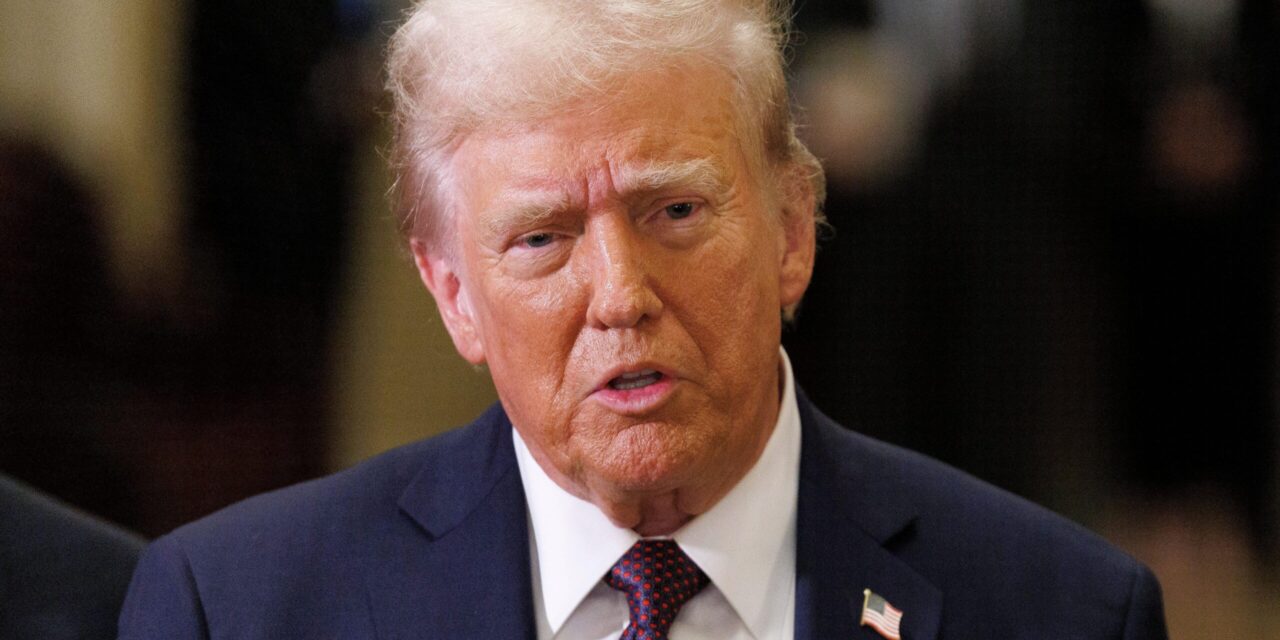
In Ohio’s former steelmaking heartland, President Donald Trump faces growing skepticism from the very blue-collar voters he has courted across three consecutive presidential election victories.
Trump returned to Ohio to rally support for Republican candidates in the final weeks of the midterm election season, appearing at the Covelli Centre in Youngstown to promote data center development.
His visit centered on boosting the campaign of Republican Sen. Jon Husted, whom Trump previously thanked for advancing legislation addressing the impact of large data facilities on local communities.
Data centers have emerged as an unexpected political liability for Republicans nationwide, with residents raising serious concerns about electricity demands and water usage that could drive up utility bills.
Opposition to data centers now outweighs support by 30 points, with polls showing the majority of Republicans oppose construction of such facilities near their communities.
A recent New York Times/Siena poll found that data centers represent a specific weak point for Husted, with voters favoring his opponent by an 11-point margin on the issue.
Husted faces a competitive challenge from former Sen. Sherrod Brown, who has aggressively attacked the incumbent over tax incentives granted to technology companies during his time as lieutenant governor.
Brown wrote on X: “Senator Jon Husted gave billions in tax breaks to Big Tech to make sure they would build their data centers in Ohio. Now, he’s making Ohioans foot the bill.”
Trump has consistently dismissed concerns about data centers, arguing the facilities provide the computing power needed for AI systems, which he has dubbed “super intelligence,” and are vital to competing with China.
The president promised his administration is working to ensure data centers “benefit local communities,” while previously warning that communities rejecting such facilities risk becoming “backwards and poor.”
Husted introduced legislation requiring large power users to shoulder more of their operational costs, but the bill was ultimately blocked by Senate Democrats despite advancing through the GOP-controlled chamber.
GOP gubernatorial candidate Vivek Ramaswamy has taken the sharpest position among Ohio Republicans, vowing to halt approval of all new data center projects on his first day in office until his “Ohioans-First” law is passed.
Ramaswamy’s proposed law would require data centers to provide free electricity to surrounding residents, a policy designed to directly address the utility cost concerns driving voter opposition across the state.
The backlash reflects a broader tension within the Republican coalition between Trump’s ambitions for American AI dominance and the economic anxieties of working-class voters in industrial states like Ohio.
